
You know the moment. One hic, then another, and suddenly someone is thrusting a glass of cold water at you or offering to give you a fright. Hiccups are one of those little bodily quirks that are completely universal, mildly embarrassing, and about as hard to stop on command as a yawn. We've all been there — in the middle of a quiet meeting or a serious conversation, and out pops that funny little sound from somewhere deep inside.
So what actually causes them? Let's give our friends and loved ones the benefit of the doubt — maybe they really are thinking of us. But anatomically, we can lay the blame on one particular muscle, and it isn't the biceps. It's a quiet, hardworking sheet of muscle resting below your lungs and above your stomach: the diaphragm.
Meet the muscle behind the mystery
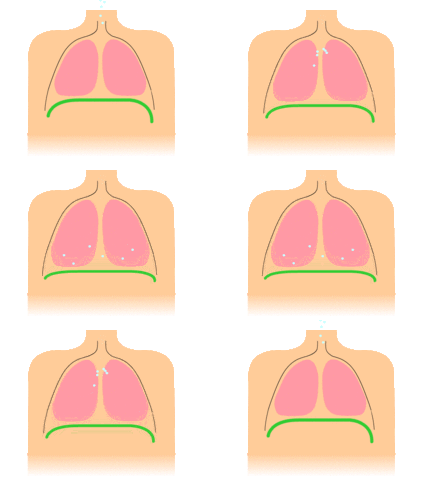
The diaphragm is your breathing partner. When you breathe in, it contracts, pulling the lower part of your lungs down and helping them expand to take in air. When you breathe out, it relaxes. Simple, smooth, mostly silent — until something makes it misbehave.
Here's the thing you might not expect: a hiccup is basically your body trying to take in air a little too quickly and a little too randomly. When you eat too fast, overeat, knock back fizzy or carbonated drinks, get overly excited, or hit a sudden change in temperature, your stomach can become stretched and irritated. That pushes against the diaphragm, setting off fast, twitchy movements that force a quick gulp of air upward. The medical name for the reflex is singultus, though most of us just know it by the sound.
Where does that sound come from?
Here's the odd part — the diaphragm spasm itself is silent. So where's the "hic"? It actually comes from your vocal cords. The sudden, uncontrolled gulp of air makes them snap shut in a hurry, and that little snap is the noise you hear. Normally you breathe without a sound; hiccups break that rule.
And the trigger isn't always the stomach. Sometimes the nerves that control the diaphragm — the phrenic and vagus nerves — get disturbed and misfire on their own. That's why a sudden scare can sometimes work as a cure: it momentarily resets those nerves back to their normal rhythm.
An echo from our amphibian past
As annoying as hiccups are for us, they may be a lifesaver for someone else. A similar hiccup-like reflex is thought to help tadpoles protect their developing lungs when they transition from breathing underwater to breathing air. That has led scientists to wonder whether we inherited the reflex from our amphibian ancestors — a leftover from way back in evolution. It's the kind of puzzle worth exploring another day.
Records, rivals, and stubborn cases
If you think your hiccups last a long time, consider Charles Osborne. Back in 1922, a pig weighing over 300 pounds fell on him, damaging a small part of his brain that normally helps stop the hiccup response. From then on, his hiccups stayed with him for around 68 years — still the longest-lasting case on record.
Who would try to compete with that? In the late 2000s, a young woman named Jennifer Mee from Florida went roughly 35 straight days with hiccups, at around 50 hiccups per minute. Talk about racing against time itself.
How to send them packing
Most hiccups resolve on their own within a few minutes. When they don't, people swear by the age-old tricks: a glass of cold water, holding your breath, a sudden scare, breathing into a paper bag, or burping — especially when feeding babies. According to studies, these mostly work as gentle distractions that help relax and reset the diaphragm, or the nerves controlling the spasms, back to normal function.
And here's the honest part: even with all this, hiccups remain a genuine scientific puzzle. There's plenty more that researchers are still working to understand about this funny, stubborn reflex. But now you know at least some of the story behind it, and you'll never hear that little "hic" the same way again. Who knows what your curious mind will figure out next. Until next time, keep up the curious talks.