
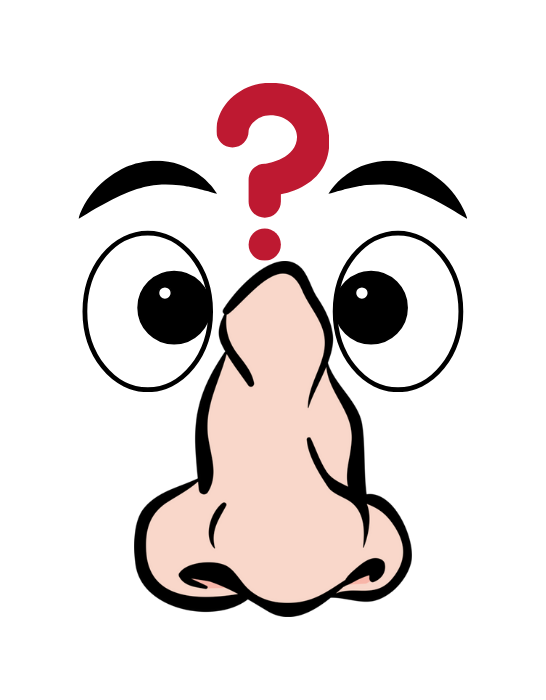
Quick test. Where's your nose? Up goes your finger, pointing right at that little bump between your eyes — easy. Now try to actually see it. Not in a mirror, not by going cross-eyed, just look at it the way you're reading this. Can't do it, can you? Unless you're Pinocchio, whose nose grew with every fib, the answer is almost certainly no.
Here's the twist, though: it's still there. Close one eye and you'll catch a faint outline of it, hovering at the edge of the frame. Open both eyes again, and — abracadabra — it vanishes. So what's going on? Your nose didn't go anywhere. The culprit is your brain, quietly editing it out of the picture.
The magician in your head
The brain's trick has a name: unconscious selective attention. And you've almost certainly felt it. Think of the last time you were lost in a book or deep in conversation. Music playing, people chatting, traffic outside — a wall of noise all around you, and somehow you filtered every bit of it out. You were giving your attention to one thing and quietly cancelling the rest.
Your brain does this constantly, and it has to. It's flooded every second with information from touch, sight, smell, sound and every other sense, while also managing heart rate, breathing, balance and a thousand internal jobs, and turning all of it into action. Think how fast you yank your hand off something hot — the skin detects the heat, the brain registers the danger, decides, and moves the hand, all in a fraction of a second. With that much to do, your attention is a precious, limited resource, and the brain guards it fiercely.
Why your nose gets edited out
Because attention is limited, the brain ruthlessly filters out anything it judges unnecessary. You don't feel every part of your body all the time — you aren't aware of your eyes, your hair, or your toenails unless something draws your notice. The same applies to what you see.
Your nose sits permanently in front of one eye and, at the edge of your gaze, in front of the other. But when your two eyes send their separate pictures to the brain, it merges them into a single clear image — and in that merge, it identifies your nose as a harmless, unchanging obstruction and simply removes it. Your eyes also tend to focus toward the centre of their field of view, shoving the nose out to the periphery, where the brain is happy to ignore it. Close one eye and the maths changes; the nose reappears as a shadow. Open both and it's gone again.
Try it right now: close one eye, then the other, and watch the ghost of your nose flicker in and out at the edge of your vision.

This filtering isn't a flaw. It's an efficiency trick — a way of sparing your limited attention for what actually matters. Without it, every constant sensation would compete for your focus all day: the weight of your socks, the hum of a fan, the blur of your own nose. The reason you can concentrate at all is that your brain is a master at sorting the important from the irrelevant, moment by moment.
The nose isn't even the brain's most impressive vanishing act. There's a spot in each eye where the optic nerve leaves the retina and there are no light-detecting cells at all — a genuine blind spot, a hole in your vision. Yet you never notice it. The brain quietly fills the gap with whatever surrounds it, patching over the hole so smoothly that you'd swear your sight was seamless. Your nose disappears in much the same way: not deleted, just filed under "known, harmless, ignore."
And your nose is doing far more than sitting there being invisible. Even unseen, it's busy warming and filtering the air you breathe, catching the scent of whatever's cooking, and quietly warning you about the world around you long before your eyes get a look.
So don't worry — you haven't misplaced your nose. It's right where it always was, front and centre. The next time you can't see it, remember: it isn't missing. It's just your brain being kind to you, hiding the clutter so you can focus on everything else. Until next time, stay curious.