
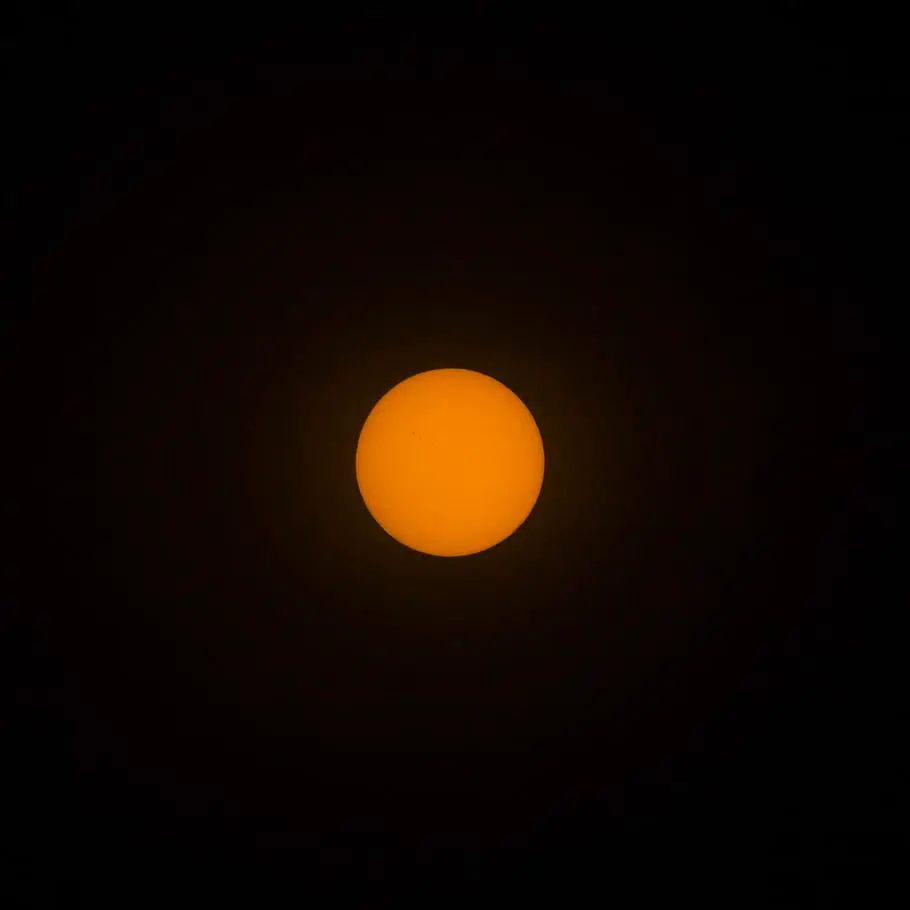
If you've ever stood outside to watch the sky turn from deep blue to shades of orange and gold at sunset, you know how mesmerizing that star overhead can feel. The Sun sits about 150 million kilometres away, and its light takes roughly eight minutes to reach us. And yet, here's the strange part of the story: that same light keeps our entire world glowing, while the vast space it travels through stays pitch black.
Stop and think about it for a second. A star so far away can brighten an whole planet. So why is the space its light crosses still dark? And if the universe is packed with billions and billions of stars, each pouring out its own light, why isn't the whole night sky blazing? Good questions — let's chase them together.
It all starts with the atmosphere
The reason we see a blue sky has everything to do with the thin blanket of air wrapped around our planet. When sunlight enters the atmosphere, it collides with the gases and tiny particles there. The light scatters — bounced and redirected rather than absorbed — and depending on how that scattering happens, you get the colours you see at different times of day. You can read all the detail in why the sky is blue and sunsets are red.
Here's the key word: atmosphere. Light travels in a dead straight line until it strikes something that scatters it. Outside our atmosphere, there simply isn't enough matter around to bounce that light in every direction and fill the view.
Cosmic dust isn't enough
Space does contain some cosmic dust and gas, but nowhere near enough. It's simply too empty — on average, the space between stars holds only about one atom per cubic centimetre. There's nothing like the dense crowd of molecules our atmosphere provides, so there's nothing to scatter the sunlight across your field of view.
Want proof? Look at the Moon. It has almost no atmosphere, so sunlight lands on its surface directly, streaming straight down with all its colours still bundled together. Stand on the Moon and look up, and you'd see only a black sky dusted with stars — even with the Sun blazing right overhead. Astronauts describe exactly that: brilliant sunlight and a jet-black sky at the very same moment.
Olbers' Paradox: why isn't the night sky blazing?
If the universe is stuffed with billions of stars, then why doesn't all their light add up to a bright, glowing wall? This contradiction even has a name — Olbers' Paradox, after the astronomer who puzzled over it. And there are a couple of good explanations.
The first is the age of the universe. Our cosmos is only about 13.8 billion years old, which means we can only see objects as far away as light has had time to travel in that span. Light moves at a fixed speed, so the light from stars beyond that reach simply hasn't arrived yet. There's a horizon of darkness we can't see past.
The second explanation is the expanding universe. When a source of light moves away from us, its wavelength stretches out — becoming redder and dimmer. The farther a galaxy drifts, the more its light shifts beyond the range our eyes can detect, until it fades from view almost entirely. That absence of detectable light is what we perceive as darkness.
Why space is cold, not just dark
You might also wonder: if the Sun is hot and we can feel its warmth, why does space feel so chilly? Same reason, really. On Earth, sunlight interacts with the molecules of our atmosphere and transfers energy to them, warming the air around us. But space is mostly empty — far too few molecules to absorb that heat and pass it along. So it stays both cold and dark, two sides of the same coin.
Science is always evolving, and it's possible a better explanation will come along in a few years — maybe from some curious mind just getting started. But for now, an expanding universe and an almost-empty space give us a solid, if humbling, answer to why the cosmos around us stays so dark.
Wait, before you go — ever wondered why you can't see in the dark? That one's about your eyes, not your surroundings: why we cannot see in the dark. Until next time, keep shining a light on that curious mind of yours.