

Christmas rolls around. You pull out the heavy padded clothes, ready to light the fireplace and settle in for a cosy winter. Meanwhile, a friend in South America looks at you as if you've lost your mind — because down there, temperatures are brushing thirty degrees. Seasons, it turns out, do not play by the same rules everywhere. And here's the twist that catches people out: when it's winter in the northern hemisphere, it's summer in the southern one.
So if you're in India, China or the USA and a friend from Argentina or Australia suggests, "let's meet in the winter," make sure you agree on the months first. Otherwise one of you is packing for the wrong season and the other is left waiting at the airport. So what actually causes the seasons? The answer is stranger — and more elegant — than most people expect.
Chapter One: the obvious answer that's wrong
Start with what we know. Earth spins on its axis, a rotation that takes about twenty-four hours and gives us night and day. It also orbits the Sun, a revolution that takes about 365 days and, together with something called the axial tilt, gives us the seasons.
Now here's where almost everyone gets tripped up. Earth's orbit isn't a perfect circle; it's slightly elliptical. So surely, you'd think, when Earth is near the Sun we get summer, and when it's far we get winter? Nope. That's not it. If distance alone drove the seasons, the whole planet would experience the same season at the same time — and we've already seen that it doesn't.
Chapter Two: the tilt is the whole story
Let's put the numbers out there, because they're the surprise. Earth's farthest point from the Sun (aphelion) is roughly ninety-four million miles away; its closest point (perihelion), about ninety-one million miles. That gap sounds enormous, but it's nowhere near enough to drive the seasons. In fact — get this — the northern hemisphere hits the depths of winter when Earth is at perihelion, its closest approach to the Sun. So much for the distance theory.
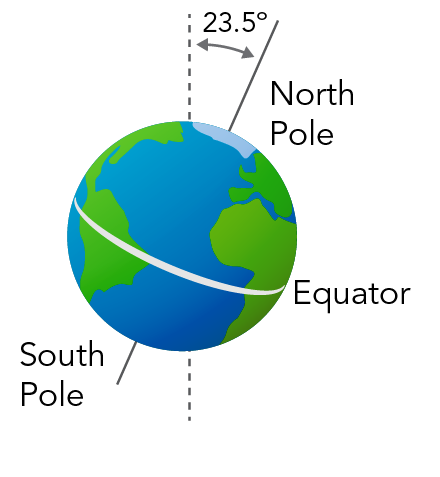
The real culprit is Earth's axial tilt of about 23.5 degrees — a lean scientists believe came from ancient astronomical collisions long ago. Because of that tilt, different parts of the planet receive sunlight at different angles as we orbit.
When the northern hemisphere leans toward the Sun, it catches sunlight more directly and the days stretch longer — that's summer. When it leans away, the sunlight arrives at a slant and spreads over a wider area, and the days shorten — that's winter. And down in the southern hemisphere, it's the mirror image at the very same moment. Nature keeps the two in perfect balance, one warming while the other cools.
Between those two extremes come spring and autumn, the in-between seasons that both hemispheres pass through on their way to the other side. But not everywhere follows such a neat pattern. Countries near the equator — like Kuwait, Singapore and Saudi Arabia — barely notice the seasons changing at all, because the amount and intensity of sunlight they receive stays fairly constant all year long.
Chapter Three: seasons are a solar-system habit
Earth isn't unique in this. Every planet in our solar system has seasons, because they all tilt to some degree — just at different angles and to different extremes. Mars goes through its own seasonal cycles much like ours, only stretched out: its year is nearly two Earth years long, so each season lasts roughly twice as long as ours. Neptune hardly belongs in the same conversation — its year is a staggering 165 Earth years, so a single season there can last around forty years. Your yearly cycle is positively brisk by comparison.
And that "approximately" I keep using for Earth's rotation and revolution? It's because the timings aren't perfectly round. If you want the details on that, here's the story: why we have leap years.
What if there were no tilt at all?
Here's a fun thought experiment to close on. If Earth's axis had no tilt whatsoever, the Sun would shine directly on the equator all year round — and the seasons, as we know them, would likely vanish entirely. That's our best understanding rather than something we can test, but it shows just how much we owe to that single 23.5-degree lean. Everything from the clothes we pack to the crops we grow hinges on it.
So the next time you pull on a coat for winter while a friend in Sydney reaches for the sunscreen, remember what's really behind it: not distance, but a quiet, ancient tilt, gently leaning us toward or away from the light. Nature's reminder that even a small angle can change the whole world. Until next time, stay curious.