
It's the rainy season, and the clouds finally break. You glance up and there it is — a bright arc of colour stretched across the grey sky: red, orange, yellow, green, blue, indigo, violet, curving out of nowhere and vanishing just as quietly. A rainbow. Even after you've seen hundreds, it still stops you for a second. But do you actually know how it works? Here's a twist that makes it even better: you don't need rain at all. A garden hose on a sunny evening will do.
What's really going on up there
Every drop of sunlight arriving from the sky is what we call white light — and white light isn't really white. It's a mixture of every colour, all travelling together and looking, to our eyes, like nothing in particular until something splits them apart. A rainbow is what that splitting looks like when it happens inside water droplets suspended in the air.
When a ray of sunlight meets a water droplet, two things happen almost at once. First comes refraction: the light bends as it moves from the thin air into the denser water. Then comes total internal reflection: the light bounces off the curved back wall of the droplet and heads back out. As it exits, it bends a second time — and because each colour bends by a slightly different amount, the colours fan apart. That fanned-out light is the rainbow.
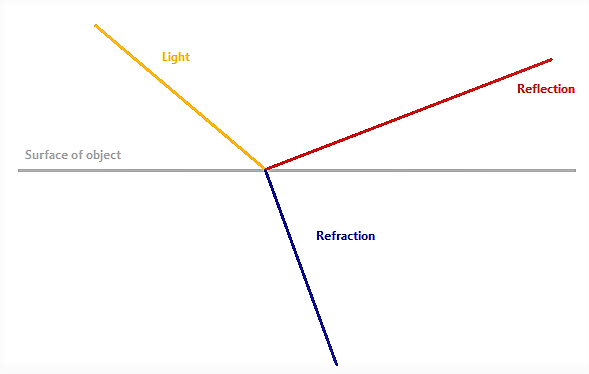
If this sounds familiar, it should. It's exactly what happens when you shine white light through a glass prism and watch a rainbow appear on the far side. Same physics — it's just playing out inside a raindrop instead of a piece of glass.
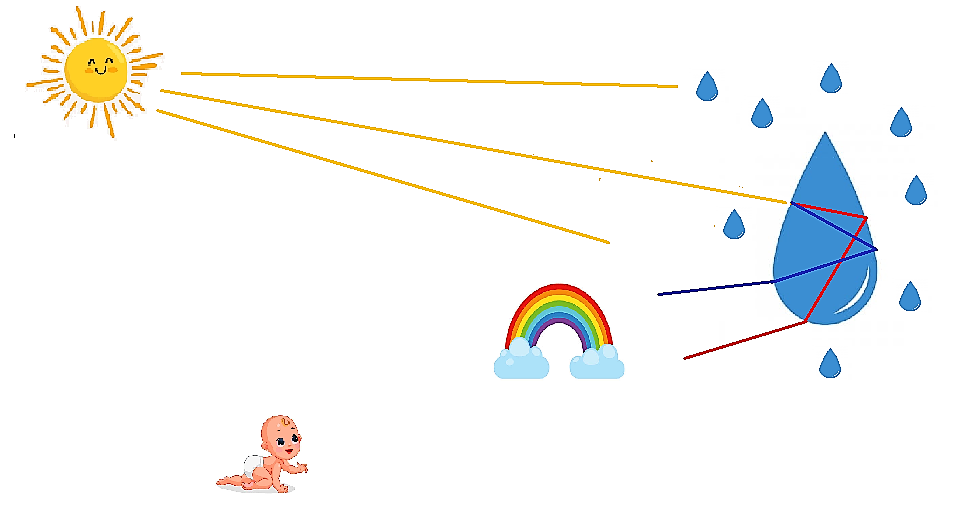
Here's where it gets cleverer still. Each colour leaves the droplet at its own precise angle — and those angles cluster around a famous figure: roughly 42 degrees. Violet bends the most and emerges at the steeper angle; red bends the least. Because of that, the red band always sits on the outside of the arc and violet on the inside. And every one of those thousands of droplets is doing the same thing at the same time, each contributing one colour to one spot in the sky. A rainbow isn't an object — it's a collaboration of millions of tiny raindrops, arranged by geometry.
How to actually see one
A few conditions have to line up before a rainbow appears in front of you:
- The sun must be behind you. The light has to travel past you, into the rain, and bounce back toward your eyes.
- The lower the sun sits in the sky, the taller and wider the arc will be. High noon rarely gives you much of a bow.
- There must be water droplets in the air — rain, mist, sea spray, or even the fine jet of a fountain or sprinkler on a sunny day.
And here's a secret that explains the whole shape: you are always at the centre of the rainbow you see. The arc forms around the point directly opposite the sun — the "antisolar point" — which for you is exactly your own shadow's head. Move, and the bow moves with you. No two people ever see quite the same rainbow, because no two people are standing in quite the same place.
What you're not seeing
Here's a bit of extra learning for the curious mind. Light isn't really made of just seven colours — there are far more, blending smoothly one into the next. Our eyes simply perceive a slice of them, and indigo in particular is hard for most people to distinguish, which is why it tends to blur into the border between blue and violet. The famous "seven colours of the rainbow" is largely a convention that stuck, not a hard boundary in the sky.
And that calm half-arc you see from the ground? That's only because you're standing on the far side of it. The rainbow is really a full circle; the ground just blocks the bottom half. Catch one from an aeroplane, with the sun behind you and rain below, and you can see the complete ring — a far more dramatic sight than the semicircle we're used to. On rare lucky occasions you'll even spot a faint second bow outside the first, with its colours reversed, created by light reflecting twice inside the droplets.
One last question worth asking: why do the droplets matter so much, when the air itself doesn't make a rainbow? Because water is a denser medium than air, and that difference in density is what bends the light and splits the colours. Change the medium, and you change everything.
If the sky's colours intrigue you, you'll enjoy the story behind why the sky is blue and sunsets are red — the same light, playing an entirely different trick.