
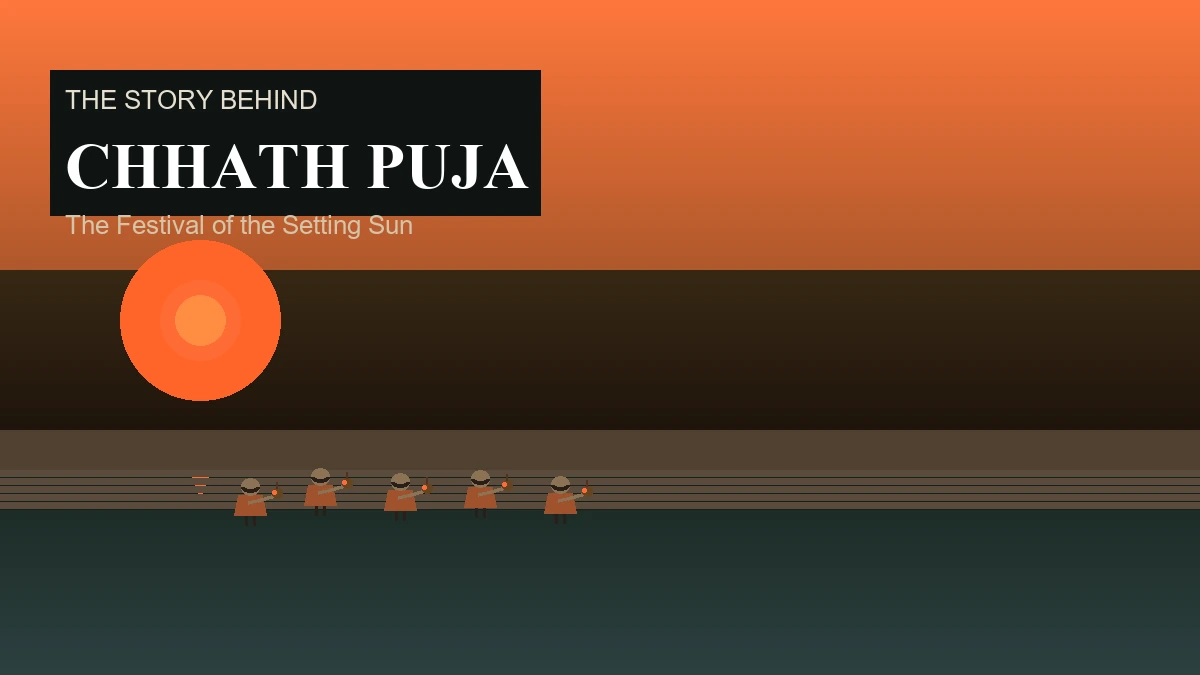
The festival that looks to the sun twice
As Kartik draws to a close, the ghats of the Ganga, Kosi, Gandak, Punpun and countless local rivers come alive at dusk. On Chhath, devotees wade into shallow water, stand facing west to offer Arghya (water offerings) to the setting sun, and return the next morning before dawn to do the same for the rising sun. This twice-daily offering to Surya is what sets Chhath apart from most other Hindu festivals.
Known widely as Chhath Puja, it is dedicated primarily to Surya (the Sun) and to Chhathi Maiya, a folk goddess closely associated with the festival across the Bhojpuri, Maithili and Angika speaking regions of Bihar, Jharkhand, eastern Uttar Pradesh and the Terai of Nepal.
1. Surya worship and its roots
Sun worship has a long history on the Indian subcontinent. Hymns to Surya appear in the Rigveda, most notably Rigveda 1.50, which praises the Sun as he drives across the sky. Elsewhere in Vedic literature, Āditya deities are invoked and the sun is seen as a witness, a sustainer and, in a broad sense, a source of life.
That said, there is no single, unambiguous Vedic mantra that prescribes the exact modern Chhath vrata as performed today. What we see is a case of continuity rather than direct textual prescription. The impulse to propitiate Surya is ancient, but the elaborate, time-bound observance with Arghya to both setting and rising sun, strict nirjala-leaning discipline, bamboo baskets (soop/dala), and the specific role of Chhathi Maiya is overwhelmingly a product of regional folk tradition that has solidified over the last few centuries.
2. Chhathi Maiya and regional oral history
In much of the tradition, the focus falls on Chhathi Maiya. Locally, she is understood as the sixth form of Goddess Shashthi, the protector of children and bestower of wellbeing for family and progeny. However, the ways in which this association is told differ from village to village.
Some families trace gratitude for a boon fulfilled. Others observe it as an act of ṛṝa (a sense of debt) to Surya for the continuity of life. What matters for a historical view is this: Chhathi Maiya is not simply "imported" from a pan-Indian Puranic list in a uniform way. She is very much a lokadevi (folk goddess) whose worship has been absorbed into, and in many places, is at the very heart of, Chhath itself.
Claims linking Chhath directly to the Mahabharata (often citing Draupadi or the Pandavas) are popular. They are found in many modern retellings, but they lack firm textual basis in the critical editions of the epic. Treating them as living tradition is fair. Treating them as documentary history is not.
3. The observance: discipline, purity and reciprocity
Chhath is renowned for its austerity. While exact rules vary by family, a few elements are near-universal across the heartland.
- Purity of space and self: The home and soop are kept ritually clean. Many observers avoid onion, garlic, meat and certain spices during the vrata.
- Fasting and restraint: Depending on the vow, devotees observe varying degrees of abstinence. On the key days, many go without food/water for long stretches before offering Arghya.
- The offerings: The basket holds seasonal produce, sugarcane, coconuts, bananas, rice flour delicacies like thekua, kasar and other homemade items. Everything is prepared with care and minimal processing.
- Arghya to both suns: The first Arghya is offered to the setting sun on Kartik Shukla Shashthi evening at the ghat. The second and climactic offering is to the rising sun the following morning, often in near-total silence with folded hands.
- Women-led character: While men actively assist with arrangements, logistics and security at ghats, the vrata is overwhelmingly observed and led by women. This has long been remarked upon by ethnographers studying the region.
4. Different traditions across regions
Chhath is best understood as a family of closely related regional traditions rather than a monolith.
- Mithilanchal (North Bihar): Strong emphasis on Chhathi Maiya, intricate rendering of traditional folk songs (Chhath geet) passed orally between generations.
- Bhojpuri belt (West/Central Bihar, eastern UP): Ghats become massive community spaces. Family groups often maintain decades-old spots passed down within the family.
- Jharkhand: Observed with equal devotion, often blending local customs whilst retaining the core Surya-Arghya structure.
- Terai region of Nepal (Madhesh): Deeply rooted, particularly amongst Maithili and Bhojpuri speaking communities with their own distinctive geet traditions.
- Global diaspora: From Delhi to Dubai, New York to Sydney, Chhath has travelled with migrants. In many cities, artificial ponds, parks or riverbanks are prepared to recreate the ghat experience with immense care.
5. A festival of ecology, labour and community
Beyond its religious dimension, Chhath is also a striking example of vernacular environmental awareness. The choice of riverbanks, the emphasis on natural offerings, minimal plastic use in many traditional baskets, and the focus on cleanliness around ghats speak for themselves.
Equally striking is the unpaid, communal labour. From clearing ghats, to building bamboo ramps, to lighting pathways, to looking out for strangers in the dark, the festival is sustained by neighbours helping neighbours with no expectation of return. For many who observe it, this seva (selfless service) is as integral to the vrata as the offerings themselves.
The real story
The honest answer is this: Chhath is a living folk tradition centred around Surya upasana with a strong local cult of Chhathi Maiya. Surya worship is ancient, but the modern form of Chhath cannot be traced to a single Vedic sūtra. Its strength lies in its regional authenticity, its rigorous yet accessible nature, its women-led character, and its ability to adapt wherever its diaspora carries it, without losing its core.
What makes it compelling is precisely what historians look for: not a frozen relic, but a tradition that has been continuously practised, negotiated and renewed by generations of families. That quiet continuity is the story behind Chhath far more accurately than any sweeping claim of unbroken Vedic origin.
Sources
- Fuller, C. J. The Camphor Flame: Popular Hinduism and Society in India (2nd ed.). Princeton University Press, 2004.
- Hutton, Ronald. The Stations of the Sun: A History of the Ritual Year in Britain. Oxford University Press, 1996.
- Kinsley, David. Hindu Goddesses: Visions of the Divine Feminine in the Hindu Religious Tradition. University of California Press, 1986.
- Vidyarathi, L. P. & Rai, B. K. The Tribal Culture of India. Concept Publishing Company, 1976.
- Witzel, Michael. "Vedic Calendar and Ecology", in Electronic Journal of Vedic Studies.