
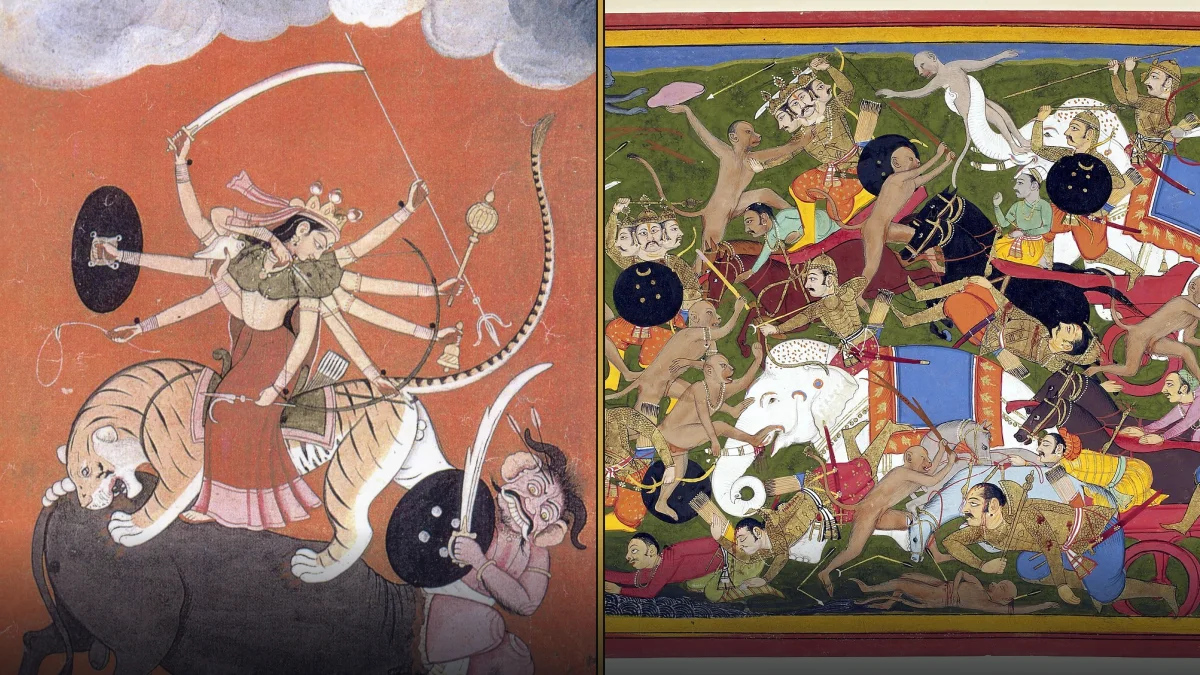
Picture the evening of Dussehra. Out in an open field, three towering effigies — the ten-headed Ravana, his giant brother Kumbhakarna, his son Meghnad — go up in a storm of firecrackers, and a whole town roars at the death of evil. Now picture the same week in Kolkata, where the goddess being carried to the river, drumbeat by drumbeat, is the one who won. Same fortnight, same devotion — Navratri and Dussehra — two completely different heroes.
Sooner or later, every curious child asks the question grown-ups tend to mumble past: is Dussehra about Rama, or about Durga? The honest answer is the most interesting one. It is both — they were never the same story — and the reason they share a date is one of the quietest joins in Hindu tradition.
The Story of Navratri: Nine Nights of the Goddess
Start with Navratri, because "nine nights" is where the calendar begins. The central scripture here is a Purana, not a Veda: the Devi Mahatmya, also called the Durga Saptashati or Chandi Path — seven hundred verses in thirteen chapters set inside the Markandeya Purana, composed around the fifth or sixth century CE. Its oldest roots reach further back, into the Vedas. The Devi Sukta of the Rig Veda (10.125), where the Goddess declares herself sovereign and the gatherer of treasures, is among the earliest hymns to the divine feminine in the tradition.
The Devi Mahatmya's great set-piece is the war with Mahishasura, the buffalo demon. Mahishasura had won a boon that no man could kill him, and drunk on that protection he seized heaven. The defeated gods poured their combined energy together, and from that blaze of shared shakti rose Durga, riding a lion and carrying the weapons of every god who had made her. What followed, the tradition says, was a battle of nine days and nine nights — the origin it gives for Navratri itself. Mahishasura kept shifting shape to escape her — buffalo, lion, man, elephant, buffalo again — and she defeated every form he wore. On the tenth day she killed him, and took the name Mahishasuramardini, the slayer of Mahishasura.
One correction, because popular retellings blur it: the nine forms of Durga worshipped across the nights — Shailaputri first, through to Siddhidatri — are not named in the Devi Mahatmya. The scripture gave the nine-night battle; later worship gave the nine goddesses.
Why Is Dussehra Celebrated? The Day Rama Killed Ravana
Stay on that tenth day — this is where the second story walks in. Dussehra (Dasara, Dashain, or Vijayadashami) lands on the tenth day of Ashvin's bright fortnight, roughly late September into October. For one whole region of Bharat, this is not the goddess's day at all. It is the day Rama killed Ravana.
The source is a different kind of text: the Ramayana, above all the version attributed to the sage Valmiki, usually treated as the oldest and most authoritative. Rama, the seventh avatar of Vishnu and prince of Ayodhya, is exiled for fourteen years; in the forest, Ravana, the ten-headed king of Lanka, carries off his wife Sita. Rama gathers allies — his brother Lakshmana, the monkey-king Sugriva, the mighty Hanuman, and Ravana's own brother Vibhishana, who turns against him. Through a long war, Ravana's son Meghnad and his colossal brother Kumbhakarna are killed. At last Rama faces Ravana himself.
Ravana is not a simple villain, and the epic knows it. Valmiki draws him as a scholar of staggering learning, a master musician, a devout worshipper of Shiva — a being so powerful that his ten heads became shorthand for everything the mind can master and everything it can ruin. He had earned a boon from Brahma that no god, demon or spirit could kill him. What he never guarded against was a man. Rama, human, stepped through that gap, and with Ravana's death dharma was restored. That is why effigies burn on the tenth night — and why the word hides a clue. Dussehra is usually traced to the Sanskrit dasha, "ten," and hara, "remover": the remover of the ten-headed one. Others read it as "the remover of ten sins," or simply "the tenth day." All three readings survive, and none is wrong enough to retire.
How Navratri and Dussehra Became One Festival
So how did a goddess's war and a prince's end up on the same day? In one of the best-loved traditions, they are deliberately braided. Before his final battle, the story goes, Rama performed an untimely — akal — invocation of Durga, calling her up out of season for the strength to win. The goddess is normally worshipped in spring, during Chaitra; Rama summoned her in autumn instead, and that autumn calling became Durga Puja. The Devi Bhagavata Purana carries the same thread, describing Rama's nine days of worship and fasting before he faced Ravana. Read that way, Navratri and Dussehra are not two festivals that collided by accident. They are two tellings of one idea — that when darkness grows too strong, something must rise to end it. Sometimes a goddess. Sometimes a man. Here, a little of both.
How Navratri and Dussehra Are Celebrated Across India
Because the streams ran through different regions, the customs are gloriously unalike. In the north and west, Ramlila plays re-enact the Ramayana across the nine nights, and Dussehra ends with Ravana's effigies in flames. In Bengal and the east, the days belong to Durga Puja — the pandals, the drums, and on Vijayadashami the sindoor khela and the goddess's tearful farewell as her idol is carried to the water. In Mysuru, Dasara honours Chamundeshwari with the grand Jamboo Savari procession. In Tamil Nadu, homes fill with Golu dolls and tools are blessed on Ayudha Puja. In Himachal's Kullu valley, alone among the variations, the festival begins — rather than ends — on Vijayadashami, as the local deities are carried in procession. And across much of India, Vijayadashami is thought an auspicious day to begin a child's education. Twenty days later come the Diwali lights, welcoming Rama home.
The Truth Behind the Two Stories
Worth saying plainly: these are two distinct stories from two distinct texts, one a Purana and one an epic, and it does the tradition no favours to melt them into one. The Ramayana is not the Devi Mahatmya, and neither is a history book. The nine forms of Durga, the precise nine nights, the akal bodhan of Rama — each is carried by later worship and regional telling, not by one original verse. What is beyond doubt is that generations found both stories worth carrying, and fitted them to the same autumn sky.
Underneath them both, the same conviction hums. Mahishasura fell because he thought his power made him untouchable; Ravana fell because he mistook what he had mastered for what he was owed. Neither is really a story about monsters. Both are the autumn echo of the same instinct that lights Holi's spring bonfire — the belief that what is evil, however many heads it wears, always has a tenth day coming. Whether you are watching an effigy burn or a goddess leave for the river, you are watching the same stubborn hope.