
It began, like so many American institutions, in the wreckage of the Great Depression. By 1934, roughly one in four workers was unemployed. Thousands of banks had failed, wiping out family savings, and older Americans, those least able to start over, were the hardest hit. For the first time in the nation's history, a federal safety net for the elderly was no longer a fringe idea. It was becoming a political necessity.
What almost nobody understands today is that the Social Security Number, now one of the most consequential numbers in an American's life, was never designed to identify anyone. It was an accounting tool, a line in a ledger, built to answer a single question: how much has this worker earned and paid in?
A Retired Doctor and the Pressure That Forced Action
Long before Congress moved, ordinary Americans were demanding relief. The loudest voice belonged to Dr. Francis E. Townsend, a California physician who in 1933 proposed the "Townsend Plan": a pension of $200 a month for every citizen over sixty, paid for by a national transactions tax. Economists considered it unworkable, but its popularity was enormous. Millions of older Americans signed petitions. Roosevelt understood that if his administration did nothing, a far more radical plan might be forced upon it. The Townsend movement helped turn an abstract debate about old-age poverty into a national emergency.
Frances Perkins and the Committee on Economic Security
The task of designing a workable alternative fell to Frances Perkins, Roosevelt's Secretary of Labor and the first woman ever to serve in a U.S. Cabinet. On June 8, 1934, Roosevelt created the Committee on Economic Security by executive order and put Perkins in charge. Her committee worked for months, drafting what became the blueprint for American social insurance. It was a delicate job: too generous and the plan would never pass Congress; too stingy and it would fail the people it was meant to help.
The Social Security Act Becomes Law
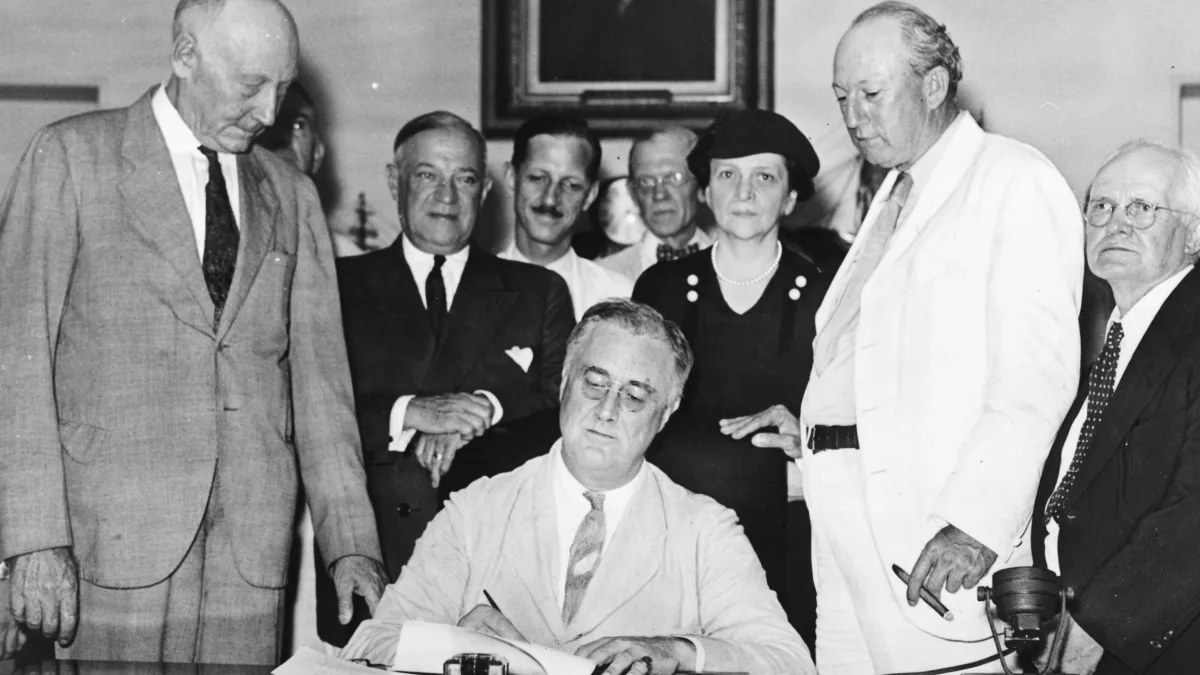
On August 14, 1935, President Roosevelt signed the Social Security Act into law. It created federal old-age benefits for covered workers and unemployment insurance administered by the states. But the law was a compromise. Domestic workers and farm laborers, the majority of whom were Black women and men in the South, were excluded, a concession to Southern legislators that kept millions of people out of the program for decades. The Act did not mention a social security number. It only authorized the government to build a record-keeping system, and the number was the tool that system would need.
A Number Meant Only to Track Earnings
On November 24, 1936, the Social Security Board began assigning numbers, many of them processed through local post offices. No one can say for certain who received the very first card, because hundreds of thousands were typed at more than a thousand centers in the same few weeks. What we can say is that when the first batch of records reached Baltimore, the one pulled from the top of the stack, number 055-09-0001, belonged to John David Sweeney, Jr. a 23-year-old from New Rochelle, New York, and it became the symbolic first SSN. The lowest possible number, 001-01-0001, went to Grace D. Owen of Concord, New Hampshire. Nearly thirty million applications were filed by the middle of 1937. The early cards carried a warning that now reads like a prophecy: "For Social Security Purposes, Not For Identification." The number itself was split into three parts, an area number tied to the state where the application was filed, a group number, and a serial number, a structure built for filing, not for proving who you were.
How the Number Escaped Its Purpose
The escape was gradual, and each step seemed practical at the time. During World War II, the military used social security numbers to keep track of personnel. On December 26, 1943, Roosevelt signed Executive Order 9397, directing federal agencies to use the number when creating new identification systems for employees. In 1961, the Civil Service Commission made it the official record number for federal workers. A year later, the Internal Revenue Service adopted it as the taxpayer identification number. Medicare, created in 1965, used it too. By the 1970s, states were using it on driver's licenses and welfare records, and banks and employers followed because it was the one number nearly every adult already had.
The National ID Debate That Never Ended
Alarm about this drift was not new. In 1973, a federal advisory committee concluded that the social security number was becoming a de facto national identifier and warned against it. Congress passed the Privacy Act of 1974, limiting how government agencies could share records, but it did not stop the number's spread into private life. When Social Security cards were redesigned in the 1980s, the words "not for identification" disappeared. There has never been a federal law declaring the Social Security Number a national ID, institutions simply adopted it, one database at a time.
Myths and the 2011 Change
Myths fill the gaps. The number's area code told you where a person first applied, but that has nothing to do with where they were born, and since June 2011 new numbers have been assigned randomly to make them harder to guess. The digits do not encode a person's age, race, or income, despite decades of speculation. The one thing the number reveals is administrative history: which office issued it and, roughly, when.
Why the Story Still Matters
Today an American needs a Social Security Number to work, pay taxes, open a bank account, build credit, rent an apartment, and collect a pension. A tracking number for a single benefit program became, by convenience and inertia, the closest thing the United States has to a national identity card. The original warning has become an ironic footnote: the card that was never meant for identification is now the key to it. The story of the Social Security Number is a reminder that systems rarely stay within the borders their creators draw for them.