
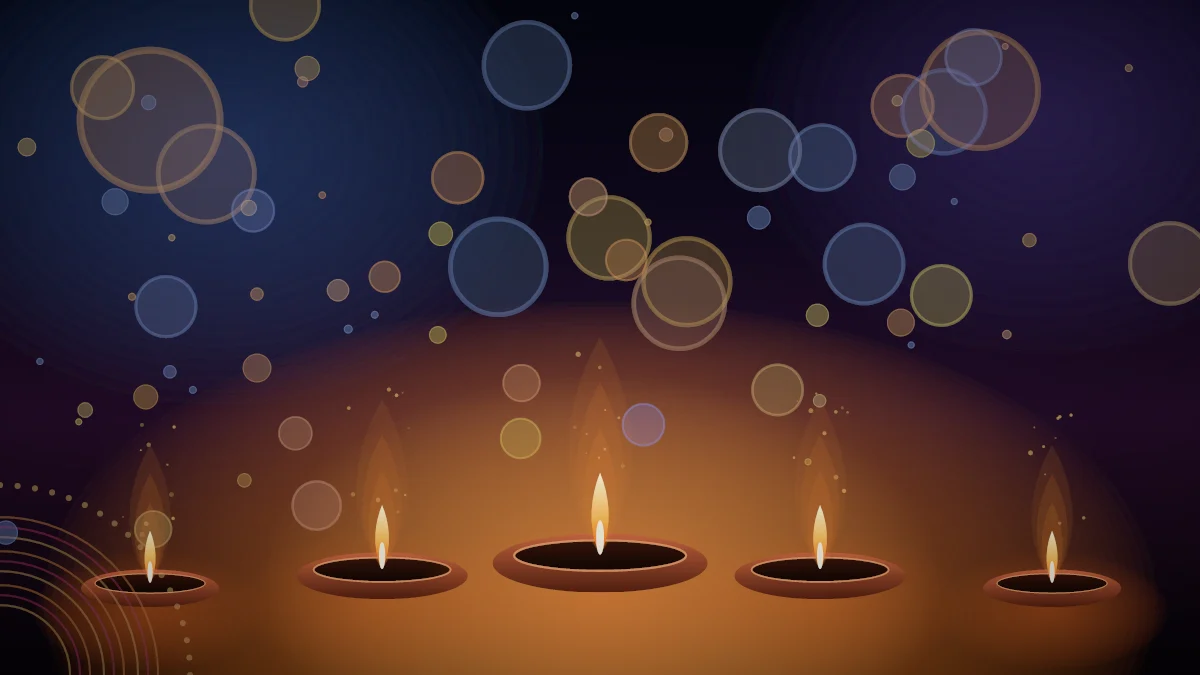
At dusk on Diwali, something quiet happens before the noise begins. In courtyards and balconies, on window ledges and shop counters, small clay lamps are filled with oil, fitted with cotton wicks, and lit one by one. For a few minutes there is only that, a line of trembling flames, the smell of ghee and earthen dust, and the sound of someone humming. Then the fireworks start.
We call it the festival of lights, but the phrase hides more than it explains. What is actually being marked? The answer depends on who you ask, because Diwali is not one story. It is a cluster of stories, layered over centuries and carried by different communities, all gathered around the same dark new-moon night.
What "Diwali" Actually Means
The name comes from the Sanskrit Deepavali: dipa (a lamp) and avali (a row). A row of lamps. In north India the word softened into Diwali; in the south and in much of the diaspora it is still Deepavali. The timing is set by the lunar calendar: the festival falls on the new moon, Amavasya, of the Hindu month of Kartik, which usually lands in late October or early November. In 2026 the main day, Lakshmi Puja, falls on Sunday, 8 November.
The Story Most People Tell
Ask a child in north India and you will hear the Ramayana. Rama, exiled for fourteen years, defeats the demon king Ravana and returns to his kingdom of Ayodhya. The city, overjoyed, lines the streets with lamps to guide him home through the darkness. That homecoming is why, in many households, Diwali is about the triumph of good over evil and the relief of a long separation finally ended.
The Other Stories Behind the Same Night
But the Ramayana is only one thread. In parts of western and southern India, the night before Diwali marks Krishna's victory over the demon Narakasura, a story celebrated as Naraka Chaturdashi. In Bengal, the same new moon belongs to Kali, worshipped as the fierce destroyer of darkness in a night of its own. And across much of India, Diwali is closely tied to Lakshmi, the goddess of prosperity, in some traditions born on this night, in others rising from the churning of the cosmic ocean.
A Note on the "Vedic Roots"
Search long enough and you will read that Diwali has "Vedic roots." The honest answer is more interesting. The festival as we recognise it is not described in the Vedas. Its clearest early associations come from the great epics and the Puranas, the Ramayana, the Krishna legends, and the Lakshmi traditions, which took shape centuries later. Light as a symbol of knowledge over ignorance is ancient, but Diwali itself is a later and still-living tradition, remade by each generation that celebrates it.
Why We Light Diyas
A diya is deliberately humble: unglazed clay, a little oil, a cotton wick. It costs almost nothing and burns for a few hours. That is part of the point. The lamp stands for knowledge pushing back ignorance, for hope in a season that is literally getting darker. Placed at thresholds and along walls, diyas are also an invitation, a way of welcoming prosperity inside, and a reminder of those first lamps said to have lit Rama's road home. Around them, families draw rangoli on the floor, patterns of coloured powder and flower petals meant to greet guests and good fortune.
The Five Days
Diwali is not a single evening but a run of days, each with its own work. Dhanteras opens the season, when many families buy new metal, gold, or utensils as a gesture of good fortune. Naraka Chaturdashi, often called Choti Diwali, recalls Krishna's defeat of Narakasura. The third day is the heart of it: Lakshmi Puja, performed in the evening with lamps, sweets, and prayers for prosperity. The fourth is Govardhan Puja, honouring Krishna's sheltering of his village under a lifted hill, or in some regions Bali Pratipada. The fifth, Bhai Dooj, belongs to siblings, when sisters pray for their brothers' wellbeing and the family gathers one more time.
One Festival, Many Indias
The variations are the story. In Gujarat, traders close old account books and open new ones on Diwali in a ritual called Chopda Pujan. In Maharashtra, the days end with Diwali Padva, celebrating the bond between husband and wife. In Tamil Nadu, many rise before dawn for a ritual oil bath on Naraka Chaturdashi. In Punjab, the same night is Bandi Chhor Divas, when Sikhs remember Guru Hargobind's release from Gwalior Fort in 1619 and his refusal to leave without the fifty-two prisoners held with him; the Golden Temple glows with lamps. Jains mark it as the night Mahavira attained nirvana at Pavapuri. In Nepal, the week becomes Tihar, five days of honouring crows, dogs, cows, and finally brothers and sisters.
From Ayodhya to the World
Diwali now travels with the Indian diaspora to London, Toronto, Durban, Singapore, and Silicon Valley, where it is marked in temples, town halls, and family kitchens. In December 2025, UNESCO inscribed Deepavali on its Representative List of the Intangible Cultural Heritage of Humanity, calling it a living tradition that strengthens social bonds. It was the sixteenth Indian element on the list, recognition not of a monument but of something people keep doing, year after year, in their own homes.
What the Lamps Are Really Saying
Strip away the fireworks and the sales, and the older meaning is still there in the flame. A diya is a small, fragile thing that gives more light than it should. Lit together, thousands of them turn a dark night into a street you can see by. That may be the simplest reading of Diwali: darkness is not defeated all at once, but lamp by lamp, by ordinary people who decide to light one anyway. In 2026, as every year, the lamps will be lit on 8 November. The details will differ from house to house. The gesture will not.