
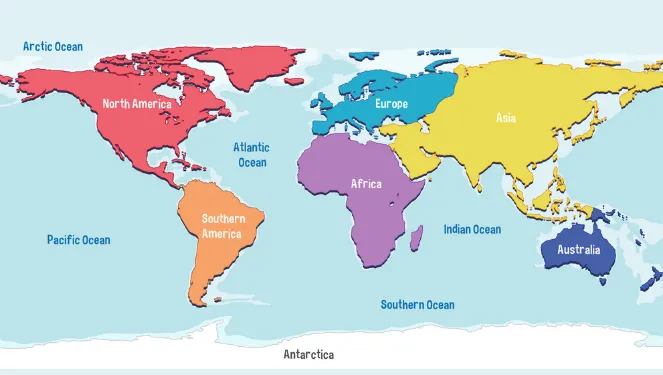
Ask anyone — anyone living in the last century or two, at least — how many continents there are, and the answer comes back without hesitation: seven. A continent, by convention, is a large, continuous mass of land ideally separated by water, and we can all rattle off the list: Australia, Asia, Antarctica, Africa, Europe, North America, South America. It is the kind of fact we memorised in school and never thought to question again.
But what if the count is wrong? There is a hidden treasure of land lying beneath the Pacific, larger than you would believe, and it is still waiting to be fully explored.
One Continent That Split Apart
To understand it, go back to the beginning. All the continents were once a single landmass called Pangaea, which began breaking apart about 200 million years ago as the great tectonic plates shifted. Those plates — vast, irregular slabs of rock, hundreds to thousands of kilometres across — make up the Earth's crust, and they are still moving.
The continent in question was only formally confirmed in 2017, though hints of it existed more than 300 years earlier. More than 90 percent of it sits under water. And the trail goes back to the 1650s, when the Dutch explorer Abel Tasman sailed the southern hemisphere and brought back the first account of something out there.
What little of it we can see has a name you already know. Does "New Zealand" ring a bell?
Meet Zealandia
Spanning roughly 4.9 million square kilometres, the continent is called Zealandia. It was once part of an ancient supercontinent, Gondwana, and apart from New Zealand its few dry scraps include New Caledonia and little else. The name itself was coined by the American geophysicist Bruce Luyendyk, as a collective term for New Zealand, New Caledonia, the Chatham Rise, the Campbell Plateau and the drowned country around them.
So vast is what remains unmapped that Zealandia still keeps geologists busy across the whole region — but while the surveying goes on, we can at least welcome the newest member of the family.
Why It Counts as a Continent
What makes Zealandia a continent and not just a scattering of islands? The answer is in the rock beneath. Continents ride on thick, light continental crust; the ocean floor is thin and dense. When geologists surveyed the sea bed under Zealandia, they found continental crust, not oceanic — a single, largely unbroken slab that simply happens to sit mostly below sea level. The team that made the case in 2017, drawing together evidence from across the region, described it in print as "Earth's hidden continent."
The name itself was not conjured from nothing: it echoes Zeeland, the Dutch coastal province whose name was carried to the Pacific as "New Zealand" long before anyone thought to apply it to the wider drowned landmass.
Continents on the Move
The continents are still drifting, driven by heat released from radioactive processes deep inside the Earth. There are even projections that they may one day gather again near the equator — a future supercontinent, around 250 million years from now, already nicknamed Pangea Ultima. It could be doomsday for most species, ourselves included. But we have time, and perhaps somewhere else to live by then. Space travel, anyone?
Back to Zealandia: it may be the smallest of the continents, yet it is still larger than the whole Indian subcontinent, and a continent all the same. We should not dismiss it the way Pluto was dismissed. Ouch — did that touch a nerve? If you want to know why Pluto is no longer called a planet, find out why Pluto is no longer a planet.
Until next time, stay curious. And the next time someone tells you how many continents there are, think twice — the map beneath the waves still has secrets left to give.