
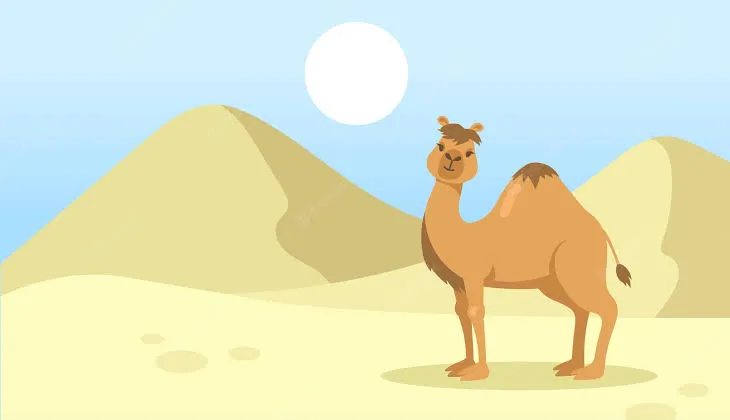
Picture the scene: you're in a desert, the last mouthful of water is gone, and ahead of you stretches nothing but sand. About thirty metres back, your camel regards you with what can only be described as a smug expression. If you've ever heard that a camel's hump is a built-in water tank, this would be the moment you start wondering about cutting the thing open. Don't. You'd be very disappointed — and you'd have ruined a perfectly good camel.
The hump holds no water. It's one of the most repeated myths in the whole animal kingdom, and the truth, as usual, is cleverer.
The Hump Is a Lunchbox
Open that hump and you won't find a reservoir. You'll find fat — almost pure fat. A camel draws on it for energy when food is scarce, which is exactly the situation a desert specialises in delivering. In a very real sense, the hump isn't a water tank at all; it's a well-packed meal the camel carries around on its own back.
You can even judge a camel's condition at a glance. When the fat is used up, the hump loses its shape — it loosens, droops, and finally flops over beside the neck in a slump. A lean, tired-looking camel with a sagging hump isn't dehydrated; it's running on the last of its reserves. Feed it well for a while and, slowly, the hump stands back up.
So Where Does It Really Keep Water?
If the hump isn't the secret, how does a camel go so long between drinks? The real answer is a whole toolbox of adaptations, each one small, all of them working together:
- Blood cells built for drought. A camel's red blood cells are oval and elastic — more like footballs than the disc-shaped cells in your blood. As the animal dehydrates and its blood thickens, those cells keep gliding through the veins without clumping, carrying what little water remains to where it's needed.
- Nothing gets wasted. A camel's faeces are dry and its urine thick and concentrated, saving moisture that other animals simply pour away. A bonus for desert travellers through the ages: dried camel dung burns well as fuel for a fire.
- Built for the extremes. Thick coats, specialised feet and an efficient breathing system that recycles moisture all help it shrug off heat that would flatten most animals — and cold that would finish others.
Just How Tough Are They?
The numbers are almost rude. A camel can lose somewhere between thirty and forty percent of its body fluid before things turn genuinely dangerous. A human face fatal risk after losing just ten to fifteen percent. And when water finally appears, a truly thirsty camel can drink dozens of litres at a sitting — swallowed fast, absorbed steadily enough not to overwhelm its bloodstream.
There are two ways of building this animal. The one-humped dromedary of North Africa, the Middle East and the Indian desert is the camel that carried the great trade routes across the sands — the famous "ship of the desert." The two-humped Bactrian camel of Central Asia evolved for colder, rockier country, and its twin humps sit higher above the ground: the same genius, tuned for a different desert.
That mountain of adaptations is evolution at its most accomplished: handed a desert and a deadline, it built an animal that counts every drop, stores every meal and rations every degree of heat. The hump in the myth was only the flashy part of a much quieter story. Next time you see one, remember — the hump isn't a canteen. It's a packed lunch, and the real miracle is the rest of the animal.
And since we're on the subject of animals that refuse to behave like the textbooks say — there's one that might outrun the whole idea of ageing. Do crocodiles really not age?