
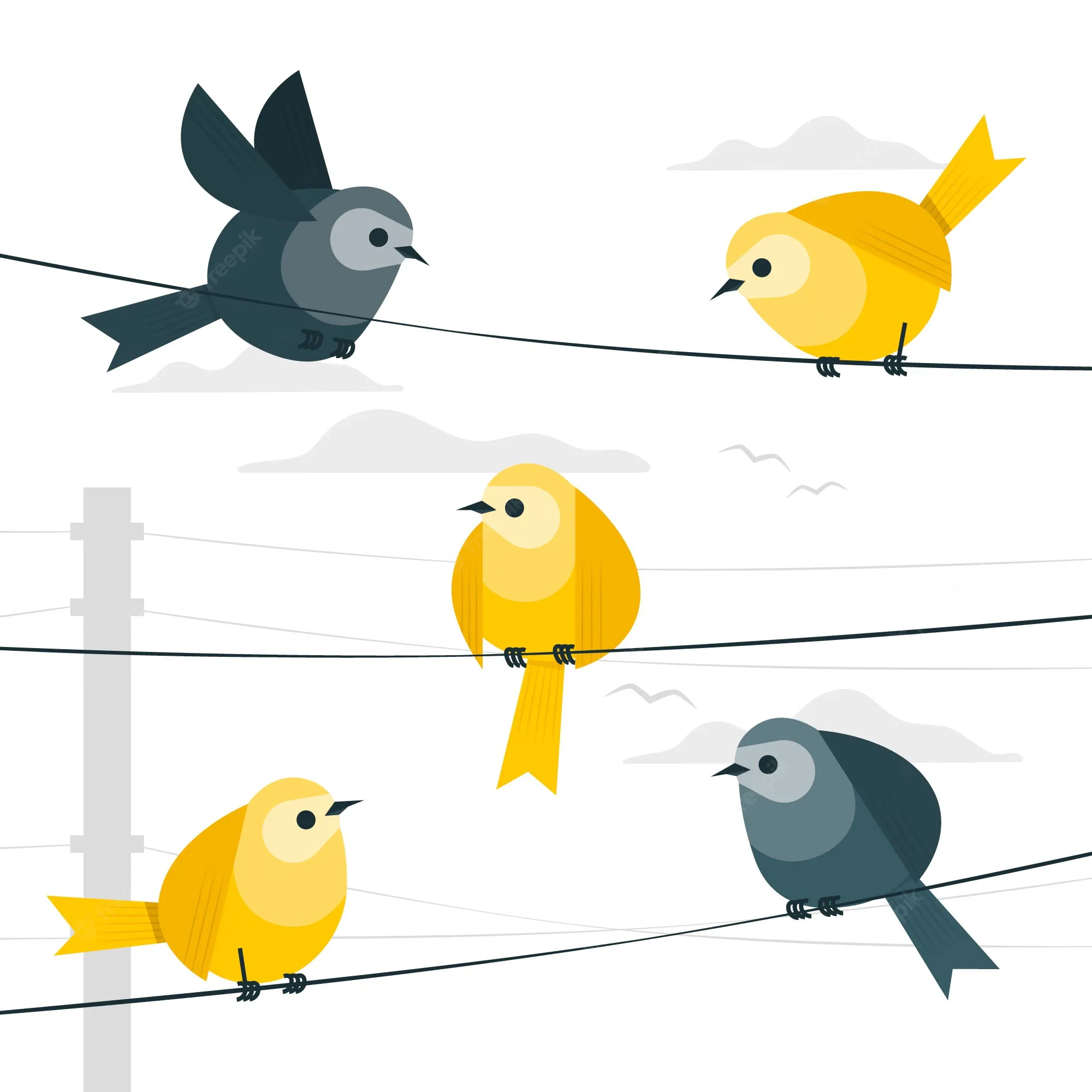
We're told from childhood to keep away from electrical wires. Don't touch them, don't poke sockets with wet hands, treat every cable as if it's live. And then you look up and there they are: birds, perched in a row on a high-voltage line, hopping along it, sometimes with a squirrel scurrying beside them. No flash, no smoke, no falling feathers. Just a perfectly calm afternoon on the wire that would kill a person.
So do birds have some natural immunity to electricity? The short answer is no. A bird would be just as badly hurt as you or me if the current ever chose to pass through it. The real reason it doesn't is buried in the principles of how current moves — and once you see it, the whole trick becomes obvious.
What current needs before it will move
Electricity is the flow of electrons through a conductor. When electrons drift along a wire, we call it an electric current. But electrons are fussy about two things. First, they need a difference in electrical potential — a kind of pressure — to push them along. No difference, no flow. Second, they need a complete path, a circuit, that carries them out and back again. That's what the wires and poles of a grid are built to provide.
There's one more rule that explains the bird. Given a choice, current favours the path of least resistance — the easiest road to its destination. The human body is a mediocre conductor; copper and aluminium are excellent ones. When both are available, the electrons overwhelmingly prefer the metal.
Why a bird on one wire is safe
Look closely at a perched bird. It's almost always on a single wire. Along that one wire, the electrical potential is essentially the same from end to end. The bird has one foot and the other both resting on the same conductor, so there is no meaningful difference in potential between the bird's feet. No difference in potential means no driving force — and without a driving force, there's no reason for electrons to detour through the bird at all.
Meanwhile, the wire itself offers far less resistance than the bird's body, so the current keeps flowing happily through the metal, past the little feathered passenger, and on toward its destination. The bird is effectively riding on top of the current, not being part of it.
There is a small subtlety worth noticing: a bird's feet sit only a few centimetres apart. Since potential drops gradually along a wire, there is technically a tiny voltage difference between the two feet — but across such a short span, it's vanishingly small, nowhere near enough to drive a harmful current through the bird. Grip a much longer stretch of a high-voltage line, as a person might, and that story changes fast.
Why the same bird would be in danger touching two wires
Now push the bird into a different situation. Suppose it lands with one foot on one wire and stretches to touch a second wire, or the grounded pole. Suddenly there's a large difference in potential between one foot and the other, and a complete path for current to take. The electrons now have every reason to race through the bird, and the shock is immediate and often fatal.
This is why birds occasionally do get electrocuted — not on a simple perch, but when their wings or a foot bridge two conductors, or when they make contact with a grounded structure. The danger was never in the wire alone; it was always in completing a circuit.
The same principle protects — and endangers — us
Humans run into the identical physics. Touch a single live wire while standing on an insulating surface, and you may survive; touch it while also touching the ground, and the earth becomes the return path, the current flows through you, and the outcome can be grim. The body always resists current to some degree, and how much flows is governed by Ohm's law — current equals voltage divided by resistance — which is why high voltages are so much more dangerous and why insulation and grounding matter so much.
So the bird isn't magical, and it isn't immune. It simply spends its life in the one place on the wire where the electricity has no reason to go through it. Move it a few centimetres onto a second conductor, and the spell breaks instantly. The magic was never the bird's at all — it was always in how electrons choose to move.