
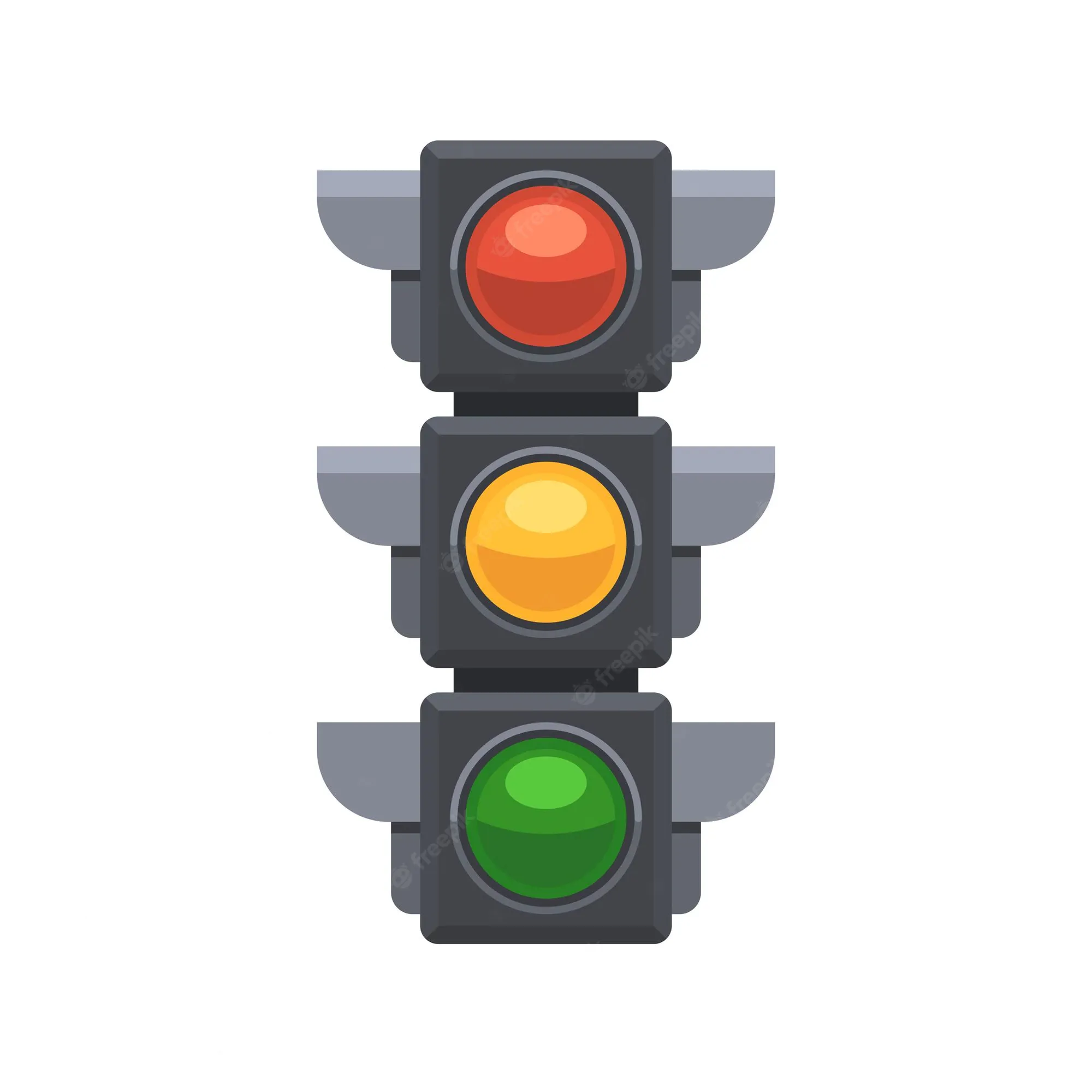
You are rolling up to a junction when the light turns red, so you stop. It goes green, so you go. It glows amber, and your foot eases off the accelerator. It is so automatic that most of us never pause to wonder about it. But why red, green and amber — and not, say, brown, indigo or pink? There are very good reasons behind that exact trio, and getting there took more trial and error than you might guess. This one has chapters, so buckle up.
Chapter One: Before the Lights
Traffic lights exist for one clear reason: to move vehicles safely through junctions — three-way, four-way — and to prevent the collisions that damage property and end lives. But they were not always automatic. Before signals took over, traffic was managed by hand, by officers posted in towers at the busiest crossings. It was hands-on work, nothing like the system we lean on today.
And here is a detail you might not expect: the colours came from the railways first. Using coloured lights to control movement was worked out on the tracks long before it ever reached the roads. Railroads taught us how to signal; the roads simply borrowed the idea.
Chapter Two: The Colour That Almost Wasn't
Now for the twist. In those early road systems, green did not mean go. Green meant caution, and a white light was the one that said "clear." That white light caused real trouble — drivers kept mistaking it for the stars in the sky. Imagine trying to tell a distant signal from a bright star on a clear night. It was a mess. After long argument, green was reassigned to mean go, and yellow stepped in as the warning colour. The arrangement we know today was not the default choice; it was earned.
Credit for the modern four-way tri-colour light goes to William Potts, who built his version in 1920. But the very first traffic signal of all appeared much earlier, and it barely survived: installed in London in 1868 outside the Houses of Parliament, it was gas-lit and operated by hand by a policeman — until it exploded and injured its operator, after which the idea lay dormant until electricity made it practical. About a decade after Potts, around 1935, official standards locked in red, yellow and green for road signs and signals — the system still used, more or less unchanged, around the world.
Chapter Three: Why These Three Colours
Why these colours, though? It comes down to the physics of light. Every colour carries its own wavelength and frequency. Picture the spectrum you learned as VIBGYOR — violet, indigo, blue, green, yellow, orange, red. Violet sits at the short-wavelength, high-frequency end; red sits at the long-wavelength, low-frequency end. And that long wavelength is exactly why red can be seen from farther away than any other colour.
It is also why the sky glows red at sunset. If you have ever wondered about that, here is the story behind blue skies and red sunsets.
Red was already bound up with danger, harm and warning for centuries, so pairing it with unmatched visibility made perfect sense. Its long wavelength cuts through rain, mist and fog, and with reflective material added it becomes a brilliant alert even in filthy weather.
Yellow sits between the two. It travels less far than red but farther than green, which makes it ideal for caution — the same reason school buses and warning signs wear it. The visibility is just that good.
Green, with its shorter wavelength, travels the least — but it carries a naturally calming quality, which made it a fitting choice for go: clearly distinct from red and yellow, yet easy on the eyes through a long day of driving.
A Bluish Twist in Japan
Here is the part worth lingering on. In Japan, the go signal is actually a bluish shade of green. It goes back centuries, to a time when the Japanese language grouped greens and blues under a single word — ao, meaning blue. They used it for green things too: aoringo, "blue apple," for a green apple; aodake, "blue bamboo," for green bamboo. To stay within international law while honouring that heritage, Japan settled on a green with a decided lean toward blue.
So the next time you wait at a red light, remember what you are really looking at: centuries of physics, history and even a little linguistics, baked into three small circles of glass. There is an explanation for almost everything. It just takes a curious mind to dig it out.