
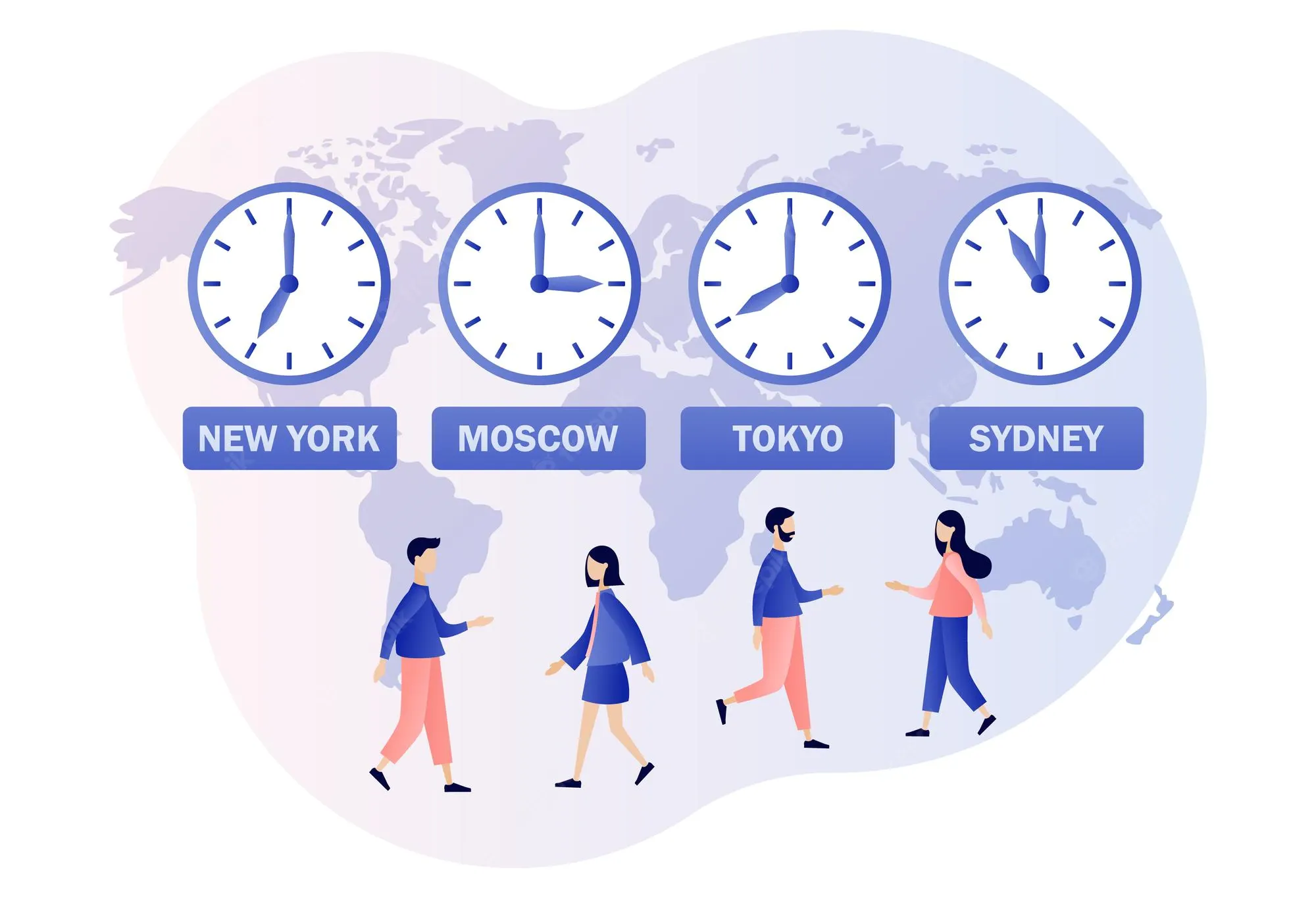
Quick question: what time is it, right where you are? Whatever the answer, somewhere else on the planet the very same moment is labelled completely differently — and the reason a single instant can answer so differently depending on where you stand is exactly what we are going to untangle.
At some point the thought has crossed your mind: why do different places keep different times? Why can it be noon in one city while another is only waking up? It sounds like the simplest thing in the world, until you start pulling at the thread — and then it turns out to have real layers.
It All Begins With a Spinning Earth
The story starts here: we live on a planet that rotates on its own axis and revolves around the Sun. Each rotation measures out a day for us; each revolution measures out a year. We learned that young. But the reason we have time zones is baked right into the rotation, and you can picture it with your own hands.
Imagine a ball spinning on an axis while you hold a torch to it. At any instant, part of the ball is lit and the rest is in shadow. As the ball turns, the bright patch slides across the surface and the shadows follow.
Now trade the ball for Earth and the torch for the Sun. As Earth spins, one half faces the Sun while the other half sits in darkness, and the intensity of that light keeps shifting with the turning. That is how we get the phases we all live by:
- Sunrise — low sunlight, intensity gradually increasing
- Afternoon — high sunlight
- Sunset — low sunlight, intensity gradually decreasing
- Night — no sunlight at all
Every region experiences these moments at a different point in the planet's rotation. Someone watching a sunset at four in the afternoon cannot be living at the same time as someone on the far side of the world watching a sunrise. That mismatch is the entire reason time zones were invented — to keep some order in the way we share time.
How the Mess Got Sorted Out
The tidy grid we rely on today was hard-won. It might surprise you to learn that, once, almost every town and city kept its own time. That was fine until the late 1800s, when the railroads turned it into a nightmare: every station ran its own clock, and confused passengers never knew which time to trust. At its worst, the railway network was juggling more than a hundred different local times.
The 24-Hour Solution
To fix the chaos, scientists studied the planet's rotation and found something useful. Every sixty minutes of rotation turns the Earth by about fifteen degrees. Multiply that by twenty-four and you arrive at three hundred and sixty — a full circle. And so the world was cut into twenty-four time zones, each roughly fifteen degrees of longitude apart.
The zero line of that system ran through Greenwich, which is how Greenwich Mean Time became the standard for setting the world's clocks. The choice was not self-evident: it was settled at an international conference in Washington in 1884, where the world's powers agreed to make Greenwich the prime meridian. Today, UTC — Coordinated Universal Time — is the term more commonly used, and it is worth noting that GMT and UTC are not quite the same thing, however often the two are spoken of interchangeably.
Not Everyone Follows the Same Rule
Most countries take the standard, but plenty add their own flavour. India, for instance, sits roughly half an hour out of alignment, running at GMT plus five hours and thirty minutes. Nepal is at GMT plus five hours and forty-five minutes. Venezuela runs at GMT minus four and a half hours. And China, enormous and spread across the map, holds to a single time zone for the whole country.
There is also daylight saving time, adopted in some regions to squeeze more use out of the available daylight.
Time zones are the world's shared reference point for telling time — but the story runs deeper still: what time really is, how gravity bends it, and more. That is a tale for another day.
So whether you are catching a sunrise or heading home at dusk, those little numbers on your screen are the product of centuries of planetary motion, railway chaos and careful coordination. Stay curious, and let the clock keep telling you where Earth has turned.